

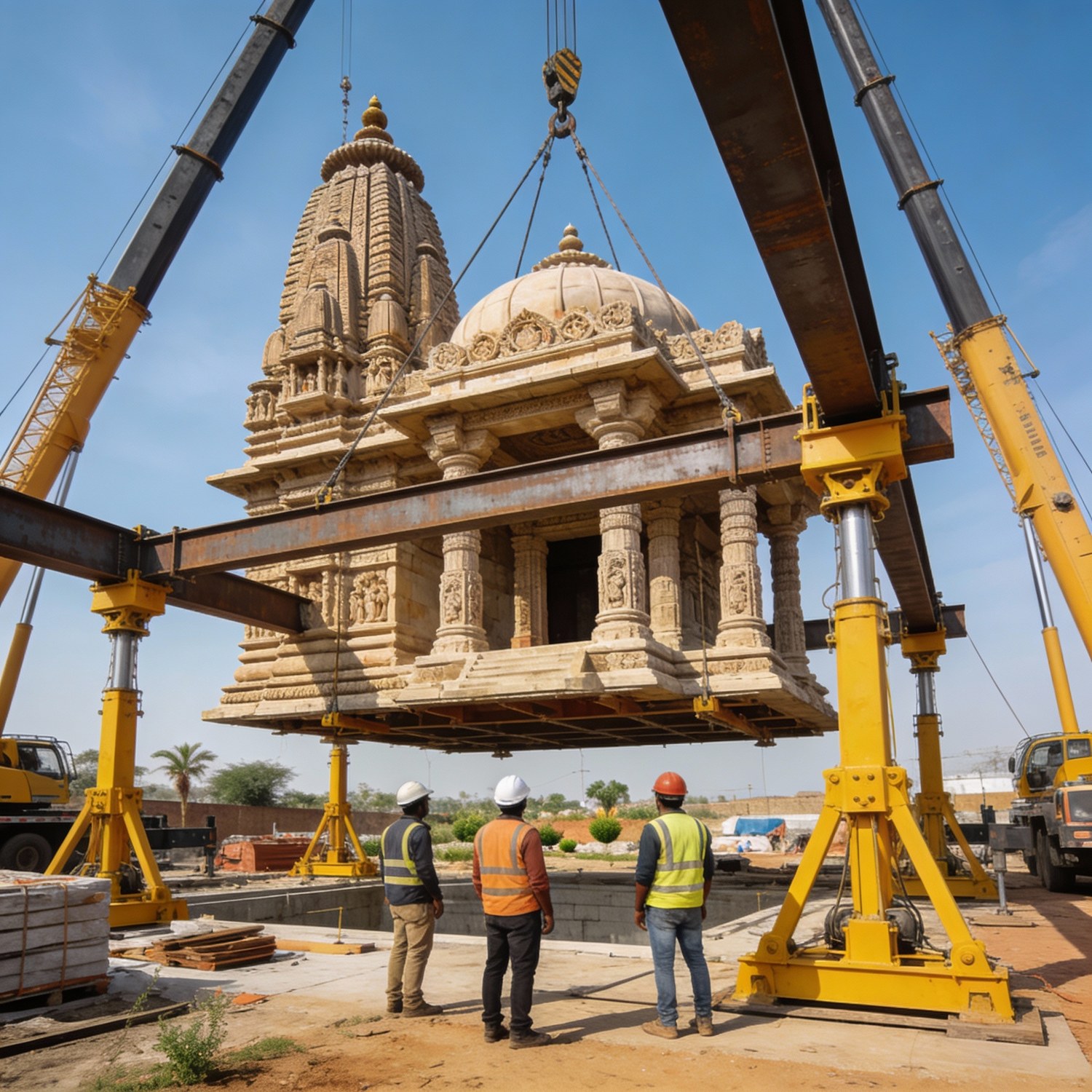

Temples are more than physical structures—they are centers of faith, heritage, and community life. When such sacred structures face challenges like flooding risks, weak foundations, road widening, or ground level changes, demolition is never an acceptable solution. This is where temple lifting services play a vital role. With careful planning, deep respect, and advanced engineering, temples can be safely lifted and preserved for future generations.
Ambey House Lifting Services has emerged as a trusted name in temple lifting services in India, combining over 10 years of experience with modern hydraulic technology to protect both the structure and the sanctity of temples.
Understanding Temple Lifting Services
Temple lifting is a specialized structural engineering process where an existing temple is raised vertically to a higher level without dismantling or damaging the structure. The entire temple—columns, walls, and roof—is lifted in a synchronized and controlled manner using hydraulic jack systems.
Unlike residential or commercial buildings, temple lifting requires a higher level of sensitivity, planning, and precision due to:
Religious importance
Architectural uniqueness
Emotional and cultural value
Often old or heritage construction
This makes professional expertise absolutely essential.
Why Temple Lifting Becomes Necessary
Across India, many temples require lifting due to practical and environmental reasons, such as:
Flood-prone locations where water enters the sanctum
Rising road or ground levels around the temple
Weak or aging foundations in old temples
Drainage and waterlogging issues
Urban development and road widening projects
In such cases, temple lifting offers a respectful and long-term solution without disturbing religious practices.
How Ambey House Lifting Services Approaches Temple Lifting
At Ambey House Lifting Services, temple lifting is approached not just as an engineering task, but as a responsibility. Each project begins with understanding the spiritual significance of the structure and the expectations of the trust or community involved.
- Detailed Structural & Site Assessment
Our engineers conduct a thorough inspection of the temple’s foundation, load-bearing elements, soil condition, and surrounding area. Special care is taken to study old construction materials and structural sensitivity.
- Customized Engineering Plan
Every temple is unique. Based on assessment findings, a custom lifting plan is designed, defining lifting height, jack placement, load distribution, and safety measures.
- Installation of Hydraulic Lifting Systems
High-capacity hydraulic jacks are installed at strategic points to ensure uniform lifting. The setup is designed to avoid vibrations and stress on delicate temple elements.
- Controlled and Gradual Lifting
The temple is lifted slowly and evenly, with continuous monitoring at every stage. This ensures:
No cracks or structural damage
Maintained alignment and orientation
Complete structural stability
- Foundation Extension & Final Stabilization
Once the required height is achieved, the foundation is strengthened or extended, and the structure is permanently stabilized.
